When somebody collapses before you, the gap between panic and action is very little. Express CPR courses exist to close that space fast, without dragging you with days of technological concept you will certainly never make use of on the street or in a workplace.
In a couple of concentrated hours, a well run fast first aid course or express CPR course can transform a spectator right into an efficient first responder. Not a paramedic, not a doctor, however a calm pair of hands that knows what to do in the essential initial minutes.
I have educated thousands of people in first aid and CPR, from childcare workers and tradies to workplace groups that did not truly want to be there. The pattern is always the same: individuals get here concerned they will not bear in mind anything, and leave stunned by just how much practical skill they can integrate in one morning.
This guide walks through what you really find out in express CPR training and fast first aid courses, exactly how those brief classes are structured, and which shortcuts are secure versus which are not.
What "Express" Really Means in CPR and First Aid Training
Many individuals look for "fast first aid course near me" or "fast CPR refresher course" due to the fact that they need a first aid certificate for work, or their childcare qualification is about to run out. Others merely recognize their attention span will certainly not endure an eight hour lecture.
In practice, express first aid or express CPR courses are usually:
- Condensed in duration, typically 2 to 4 hours for CPR just, or half a day for combined first aid and CPR courses. Focused on core life saving skills and assessment, with theory completed in advance online. Highly useful, with most time spent on manikins, situations, and trainer feedback. Designed for fast certification without giving up the across the country needed performance criteria in your region.
The trick difference is not what skills you find out, however exactly how the understanding is structured. A traditional complete day first aid training course will certainly cover concept, discussion, and method in the exact same area. An express first aid course pushes a lot of the concept into pre course eLearning to ensure that class time is hands on.
If you are available in having actually finished the on the internet modules, the "express" part works extremely well. If you click via the theory without taking note, the practical session can really feel overwhelming. The course size did not fail you, the prep work did.
Core Skills You Can Expect From an Express CPR Course
A well run express CPR training session is tightly focused. By the end, you must have the ability to:
- Recognise a heart attack quickly and call for aid early, consisting of using neighborhood emergency numbers correctly. Perform excellent quality chest compressions at the best deepness and rate, and reduce interruptions. Use a defibrillator (AED) confidently, consisting of pad positioning and safety and security checks. Combine compressions with breaths making use of a barrier gadget, or switch to compression just CPR when appropriate. Work as part of a small group, rotating compressors and collaborating with bystanders till emergency situation solutions arrive.
Those seem like basic factors, yet doing them under stress and anxiety takes method. In the training room, good teachers will recreate a little bit of that stress and anxiety in a controlled way. They could start the timer, go back, and say absolutely nothing while you determine whether to shake, shout, call, or compress first. That tiny uncomfortable pause is deliberate. It requires you to lead, not simply follow instructions.
Underneath those heading abilities, there is a collection of mini abilities that actually matter in real life first aid and CPR:
You find out how to identify agonal breathing, those uneven gasps that are often mistaken for normal breaths. You obtain utilized to stooping for several minutes of compressions, not simply twenty practice presses. You exercise how to move clothing, location AED pads, and start the shock cycle without losing your rhythm.
Express CPR courses can not cover every medical nuance, yet they definitely can install those habits.
How Express CPR Matches Wider Fast First Aid Courses
Many individuals integrate CPR with wider first aid in one sitting, either with express first aid courses or packaged first aid and cpr training classes. In those blended formats, the CPR part is normally the most tightly examined component of the day.
A fast first aid course that consists of CPR will normally structure the moment similar to this, with some variation between providers:
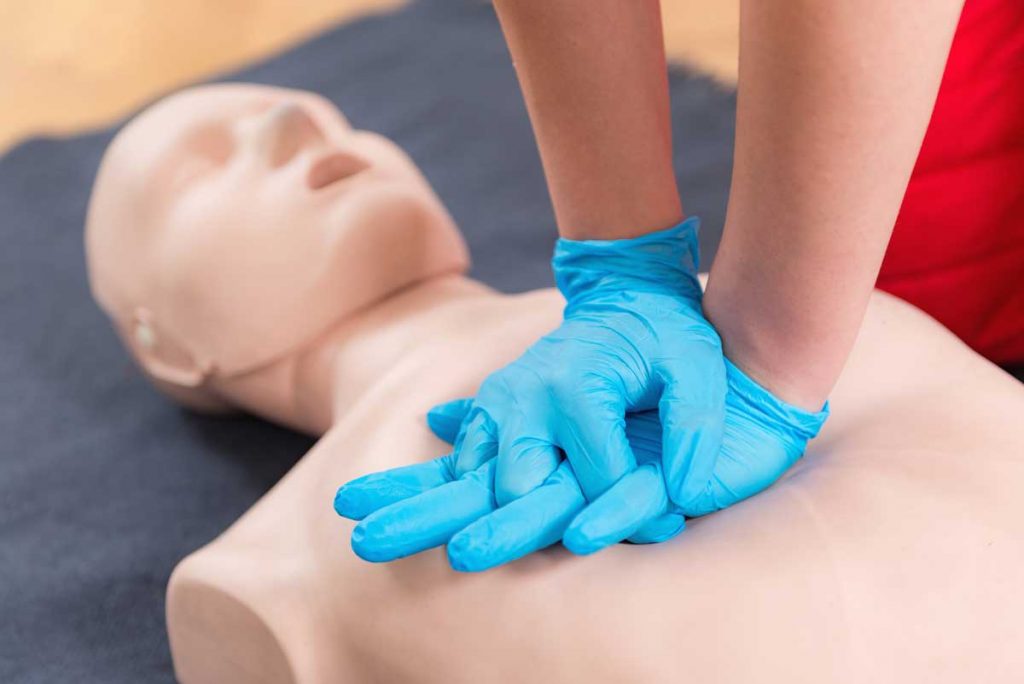
First, a brief wrap-up of the DRS or ABCD action plan you ought to currently have actually seen in your pre learning. After that, a deep useful study CPR on adult manikins, often followed by baby and kid manikins if the course includes family members or childcare content.
Only as soon as those useful skills feel solid do trainers usually relocate onto various other fast first aid topics like choking, bleeding control, burns, and standard medical emergencies.
From an instructor's point of view, this sequencing is calculated. CPR is both physically demanding and psychologically exhausting. If you leave it throughout of the express first aid training, people are fatigued, and the quality of compressions drops.
When you see course descriptions that claim "first aid and CPR course," CPR and first aid training program "first aid and CPR training classes," or "fast first aid courses," they normally describe this type of blended framework: CPR as the core skill, with other first aid layered around it.
What You In fact Practise, Step by Step
A great deal of people presume CPR courses are simply somebody reading off a PowerPoint while you half heartedly push on a manikin. Great express cpr training is much more physical and specific.
During a solid session, you can expect to resolve a series of drills that slowly stack:
Scenario entrance: You come to a manikin that represents a broken down person. You check for risk, introduce yourself, and evaluate responsiveness. The trainer may function play a distressed onlooker or stressed relative to include realism.
Breathing analysis: You practice opening the air passage, looking for normal breathing, and calling for assistance. Below, trainers typically appropriate small but vital routines, like tilting the head also far back in babies or investing also lengthy checking for breaths.
Compression method: You spend focused time accessible positioning, arm lock, deepness, and rate. Several manikins currently have responses systems that show if compressions are too superficial or also slow. You will certainly feel the difference between tired compressions and fresh ones. That experience issues when you encounter a real person who is not responding.
Adding breaths: As soon as your compressions look strong, you include rescue breaths, often with a face guard or pocket mask. Lots of people struggle initially with developing a seal or delivering adequate air without over blowing up. This is where repeating makes the difference.
AED integration: Finally, you integrate everything with an automatic exterior defibrillator. You practice turning it on, adhering to the motivates, affixing pads on grown-up and infant manikins, clearing before the shock, and resuming compressions promptly.
By the end of an express cpr course, you must be able to move through those actions without stopping to remember what comes next. You may still really feel nervous, however you will certainly have a physical memory of kneeling next to a "individual" who needed you to act.
Key Differences for Express Child Care First Aid and CPR
If you work with youngsters or hold obligation for infants, you need to not rely only on adult cpr training. Express child care first aid courses concentrate on scenarios and techniques particular to children and youngsters, where makeup and risks differ.
In express child care first aid training, you still discover the core sequence of evaluation, compressions, and AED usage, yet with various details:
Compressing a little chest with 2 fingers rather than your complete body weight. Changing the head tilt for a baby so you do not tighten the airway. Recognising choking in a young child who may not have the ability to talk or indicate plainly. Managing common childcare injuries like falls, burns from hot fluids, or poisoning from family products.
An express childcare first aid course often really feels more psychologically extreme for moms and dads and educators. Trainers need to allow room for that, while basing everything in sensible repeating. You will certainly invest prolonged time with baby manikins, and typically run through a number of short childcare details scenarios, from play area cases to sleep time emergencies.
If you are determining in between basic express first aid courses and express childcare first aid courses, utilize your day to day risk account as the overview. A building worker requires various emphasis than a preschool instructor. Lots of service providers offer both, and some provide mixed express child care first aid and CPR courses that please governing needs for very early childhood education.

How Brief Is Too Short?
The need for fast certification is reasonable. No one desires their weekend break taken in by a course they see as a box ticking exercise. However there is a useful reduced restriction to how "express" safe CPR first aid courses in Perth and first aid training can be.
In my experience, anything under 90 mins of real, personally CPR technique time starts to really feel rushed, specifically for first time students. People need time for:
Initial nerves and awkwardness, especially if they have never ever touched a manikin or seen an AED. Numerous method cycles, consisting of at least one long continual round of compressions to feel tiredness. Private feedback and correction, which takes time when you have a team of 8 to 12 participants.
An absolutely responsible express CPR course may be arranged for 2 to 3 hours, with around half of that as pure hands on time. The remainder is invested evaluating safety and security, responding to questions, and assessing participants.
Online only "fast CPR" or "fast first aid" choices that issue certificates with no functional analysis are where high quality commonly falls off. They might satisfy some reduced level plan demand on paper, however they do not produce muscle mass memory, and they do not educate you just how it really feels when your very own adrenaline kicks in.
If you are comparing fast first aid training service providers, ask candidly how many minutes you will in fact spend on the flooring practising compressions and AED use. The solution should be a real number, not "we cover everything you need."
Choosing an Express CPR or First Aid Course That Still Has Substance
With a lot of cpr courses and first aid courses marketed as "express," "fast," or "blended," it can be tough to tell which ones are worth your time and money.
To different solid express cpr courses from superficial ones, seek:
- Accreditation or acknowledgment by your sector or regulatory body, not simply a common "certificate of completion." Clear mention of practical assessment, including CPR on an adult manikin and, if appropriate, kid or baby manikins. A mixed shipment version, where first aid concept is finished online and class time is stressed as hands on. Trainers with genuine area experience, such as paramedics, nurses, or skilled office first aid instructors. Course period that allows at least 90 mins of functional CPR, even in a fast cpr or fast first aid course.
If a company assures you a first aid certificate or CPR card "in under an hour" without leaving your desk, treat that as an awareness module, not a full express first aid course. Those very brief, simply on the internet items might rejuvenate your memory, but they are not a substitute for pressing on a manikin until your arms shed a bit.
Fast certification is not naturally negative. The problem is when "fast" ends up being shorthand for "checkbox only." A good service provider is clear about the limits of express first aid and cpr training, and will suggest a longer layout if your role needs greater competency.
What About Refresher Courses?
Skills weaken in time. That is not a character problem, it is simply just how memory works when we do not practise. Study and long experience both reveal that CPR high quality goes down significantly within 6 to year if you never ever utilize it.
This is why numerous offices currently require regular fast cpr correspondence course, usually annually, even if the formal certificate might be valid for a longer duration. Refresher layouts are a perfect suitable for express cpr training, due to the fact that you are building on an existing base rather than starting from zero.
A good refresher concentrates less on training and even more on testing, dealing with, and updating. You may invest even more time on situations, operate in teams, or practise variations like compressions just CPR. Instructors will certainly additionally update you on any changes in standards, for example, modifications to recommended compression deepness ranges or AED pad placement in special cases.
If your last first aid and cpr course was years back, anticipate your first refresher to feel almost like a full course once again. That is typical. After that very first return, much shorter yearly refreshers feel truly "express" because the primary patterns come back quickly.
How Much Theory Do You Actually Need?
One concern people usually have with express first aid or express CPR courses is that they will certainly not "cover sufficient theory." This concern typically originates from a good place, but it can be misplaced.
In an emergency situation, your brain does not have time to keep in mind the detailed physiology of heart output or the specific names of heart rhythms. What it requires is a handful of clear, easy rules that you can recall under stress.
For CPR, these rules are essentially:
If a person is less competent and not breathing generally, begin compressions and send for an AED. Press set in the facility of the chest, with marginal interruptions. Adhere to the AED motivates and maintain going till emergency solutions take control of or the individual recovers.
There is naturally more nuance, especially in first aid courses that additionally cover shock, bleeding, strokes, asthma, or anaphylaxis. Express first aid training addresses that subtlety via brief, focused descriptions and scenarios, shortly lectures.
The technique is knowing which theory issues for lay responders and which does not. For instance:

You do need to comprehend the indicators that recommend stroke, cardiovascular disease, or an allergic reaction, because very early acknowledgment triggers very early aid. You do not need to memorise medication names or complex analysis criteria.
You do need to know how to store and use an adrenaline car injector for anaphylaxis. You do not need ten mins on the pharmacology of epinephrine.
The best express first aid courses and express cpr courses will quietly filter this for you. They will provide you enough background to ensure that the steps make good sense and you trust them, yet they will always bring you back to the concern, "What would certainly you actually make with your hands in this situation?"
The Physical Side of CPR That Courses Seldom Advertise
One reality many people only uncover during training is that CPR is effort. After 2 mins of top quality compressions, the majority of adults are breathing heavily and their arms are drinking a little. In real cardiac arrests, bystanders often continue for 10 to 20 mins until professional assistance arrives.
Express CPR training need to prepare you for that physical load. That means not just learning the correct technique as soon as, however practising with exhaustion and understanding when to turn with one more rescuer.
If you are the only individual available, you additionally require methods to manage your own body:
Setting on your own up in a sustainable setting at the beginning, close enough to the upper body that you can lean from your hips instead of pumping with your arms just. Utilizing your body weight efficiently so you are not wasting power. Accepting that you will certainly feel worn out and sore and doing it anyway, because incomplete CPR is still much better than no CPR at all.
In my classes, once individuals show decent method, I commonly state, "Keep going until I inform you to quit." I after that allowed them benefit a number of mins beyond their convenience area. That experience is very useful. A 2 hour express cpr course that includes even 1 or 2 lengthy cycles similar to this offers you a far more realistic concept of what an actual arrest will certainly feel like.
Certificates, Compliance, and Real Competence
For lots of people, the major motorist to book a fast first aid course or express cpr course is conformity. They require proof for a job, a professional registration, a visa application, or a work environment audit.
There is nothing incorrect with that. A legitimate first aid certificate is part of just how organisations show that they take safety and security seriously. The problem is when the certificate comes to be the goal and actual capability is treated as optional.
When you pick a carrier, ask on your own two questions:
Does this course satisfy the formal demand for my role or industry? Does this course provide me adequate skill that I would trust myself to act if an associate, child, or unfamiliar person broke down in front of me?
A well structured express first aid or express cpr training session can do both. It can tick the box for regulatory authorities and genuinely furnish you to manage emergency situations in your setting. You should leave with a certificate in your hand and the sensation that your time was well spent.
If the only point you bear in mind from your last fast first aid course is signing the participation sheet, it might be time to find a various trainer.
Making the Most of a Short Course
Express courses function best when participants make a small investment prior to and after the actual class.
Beforehand, take the pre course eLearning seriously. It is appealing to hurry via video clips and quizzes, however that theory sets the stage for important hands on time. Also 30 minutes of concentrated attention the evening prior to makes a large distinction. If your course consists of work environment certain content, think of the real threats in your setup so you can ask targeted questions.
During the session, treat every circumstance as if it were real. Speak out loud, utilize names when calling for help, and move with function. The even more you submerse on your own, the stronger the memory trace your mind creates.
After the course, promptly evaluate your notes or the course handbook one or two times over the adhering to week. If you have access to a training manikin at work, even a couple of minutes of compressions every number of months will maintain the skill from fading.
Express first aid and CPR courses regard your time by focusing on what issues most. If you fulfill that initiative midway, you can entrust confidence that when the most awful happens, you will not be standing frozen, wondering what to do. You will certainly have a clear series in your head, examined with your own hands, all set to utilize when it counts.